This op-ed piece was just too good to not repost. I will be honest with you, I think it is going to make some people uncomfortable. It made me a little bit uncomfortable, but as Christians, I think we are called to live with a little discomfort. Enjoy!
Learning From the Sin of Sodom
By NICHOLAS D. KRISTOF
Published in the New York Times: February 27, 2010
For most of the last century, save-the-worlders were primarily Democrats and liberals. In contrast, many Republicans and religious conservatives denounced government aid programs, with Senator Jesse Helms calling them “money down a rat hole.”
Over the last decade, however, that divide has dissolved, in ways that many Americans haven’t noticed or appreciated. Evangelicals have become the new internationalists, pushing successfully for new American programs against AIDS and malaria, and doing superb work on issues from human trafficking in India to mass rape in Congo.
A pop quiz: What’s the largest U.S.-based international relief and development organization?
It’s not Save the Children, and it’s not CARE — both terrific secular organizations. Rather, it’s World Vision, a Seattle-based Christian organization (with strong evangelical roots) whose budget has roughly tripled over the last decade.
World Vision now has 40,000 staff members in nearly 100 countries. That’s more staff members than CARE, Save the Children and the worldwide operations of the United States Agency for International Development — combined.
A growing number of conservative Christians are explicitly and self-critically acknowledging that to be “pro-life” must mean more than opposing abortion. The head of World Vision in the United States, Richard Stearns, begins his fascinating book, “The Hole in Our Gospel,” with an account of a visit a decade ago to Uganda, where he met a 13-year-old AIDS orphan who was raising his younger brothers by himself.
“What sickened me most was this question: where was the Church?” he writes. “Where were the followers of Jesus Christ in the midst of perhaps the greatest humanitarian crisis of our time? Surely the Church should have been caring for these ‘orphans and widows in their distress.’ (James 1:27). Shouldn’t the pulpits across America have flamed with exhortations to rush to the front lines of compassion?
“How have we missed it so tragically, when even rock stars and Hollywood actors seem to understand?”
Mr. Stearns argues that evangelicals were often so focused on sexual morality and a personal relationship with God that they ignored the needy. He writes laceratingly about “a Church that had the wealth to build great sanctuaries but lacked the will to build schools, hospitals, and clinics.”
In one striking passage, Mr. Stearns quotes the prophet Ezekiel as saying that the great sin of the people of Sodom wasn’t so much that they were promiscuous or gay as that they were “arrogant, overfed and unconcerned; they did not help the poor and needy.” (Ezekiel 16:49.)
Hmm. Imagine if sodomy laws could be used to punish the stingy, unconcerned rich!
The American view of evangelicals is still shaped by preening television blowhards and hypocrites who seem obsessed with gays and fetuses. One study cited in the book found that even among churchgoers ages 16 to 29, the descriptions most associated with Christianity were “antihomosexual,” “judgmental,” “too involved in politics,” and “hypocritical.”
Some conservative Christians reinforced the worst view of themselves by inspiring Ugandan homophobes who backed a bill that would punish gays with life imprisonment or execution. Ditto for the Vatican, whose hostility to condoms contributes to the AIDS epidemic. But there’s more to the picture: I’ve also seen many Catholic nuns and priests heroically caring for AIDS patients — even quietly handing out condoms.
One of the most inspiring figures I’ve met while covering Congo’s brutal civil war is a determined Polish nun in the terrifying hinterland, feeding orphans, standing up to drunken soldiers and comforting survivors — all in a war zone. I came back and decided: I want to grow up and become a Polish nun.
Some Americans assume that religious groups offer aid to entice converts. That’s incorrect. Today, groups like World Vision ban the use of aid to lure anyone into a religious conversation.
Some liberals are pushing to end the longtime practice (it’s a myth that this started with President George W. Bush) of channeling American aid through faith-based organizations. That change would be a catastrophe. In Haiti, more than half of food distributions go through religious groups like World Vision that have indispensable networks on the ground. We mustn’t make Haitians the casualties in our cultural wars.
A root problem is a liberal snobbishness toward faith-based organizations. Those doing the sneering typically give away far less money than evangelicals. They’re also less likely to spend vacations volunteering at, say, a school or a clinic in Rwanda.
If secular liberals can give up some of their snootiness, and if evangelicals can retire some of their sanctimony, then we all might succeed together in making greater progress against common enemies of humanity, like illiteracy, human trafficking and maternal mortality.
Showing posts with label global missions. Show all posts
Showing posts with label global missions. Show all posts
Sunday, February 28, 2010

Friday, November 6, 2009
Back from Guatemala, Snow Boots and Flip-Flops and other contrasts
I arrived safely back from Guatemala on Thursday night. It was great to be back with Jessica, Lil' A-P and Sol. We are mid-way through Week 34 of the pregnancy and cannot wait to meet our little girl.
Today I took a "travel comp" day to get caught up on things around the house and run some errands that I had neglected during my trip to Guatemala. I raked the leaves in the yard, cleaned the house, did some small home improvement projects and got caught up on work at Wellshire Presbyterian Church where I am the Youth Director.
The temperature today in Denver was in the high 70s. Just last week I was shoveling 20 inches of snow off my driveway and sidewalk. I love living here in Denver, a city of contrasts. We have almost two feet of snow one week and I am tromping around in my Sorel snow boots and the next week we have temperatures in the high 70s and I can walk around in my flip-flops. A few winters ago, I even went skiing on a Saturday and golfing on a Sunday.
These contrasts in temperature and weather are not so common in Guatemala. The weather tends to be pretty even keel there. However Guatemala is a land of contrasts, just not contrasts of temperature.
The contrast in Guatemala is the incredible wealth and the oppressive poverty. Last time I was in Guatemala I was visiting a coffee plantation. I saw workers in the field that were making an average of $300 per month, just a little more than minimum wage in Guatemala. While I was talking with one of the plantation workers a loud noise caught our attention. It was the owner of the coffee plantation, arriving to work in his own private helicopter.

The wealth in Latin America is impressive, even by our own standards here in the United States. One of the richest men in the whole world, Carlos Slim, is a Mexican. The upper classes in Latin America live well. Which is why it contrasts so much with the impoverished masses, the folks we have the privilege of working with in Healing Waters International.
I never cease to be amazed by the spirit of the people we work with. Despite extreme poverty contrasted with such wealth, the people we work with have profound faith and an incredibly positive outlook.
The class system in Latin America is not as rigid as the caste system of India, but the chance of moving from the lower classes to the upper classes is pretty slim. Despite this, and despite having this class contrast front and center every day with helicopters landing in coffee fields and Land Rovers and Mercedes driving by urban slums, the people we work with find joy in their lives, their families and their faith.

Today I took a "travel comp" day to get caught up on things around the house and run some errands that I had neglected during my trip to Guatemala. I raked the leaves in the yard, cleaned the house, did some small home improvement projects and got caught up on work at Wellshire Presbyterian Church where I am the Youth Director.
The temperature today in Denver was in the high 70s. Just last week I was shoveling 20 inches of snow off my driveway and sidewalk. I love living here in Denver, a city of contrasts. We have almost two feet of snow one week and I am tromping around in my Sorel snow boots and the next week we have temperatures in the high 70s and I can walk around in my flip-flops. A few winters ago, I even went skiing on a Saturday and golfing on a Sunday.
These contrasts in temperature and weather are not so common in Guatemala. The weather tends to be pretty even keel there. However Guatemala is a land of contrasts, just not contrasts of temperature.
The contrast in Guatemala is the incredible wealth and the oppressive poverty. Last time I was in Guatemala I was visiting a coffee plantation. I saw workers in the field that were making an average of $300 per month, just a little more than minimum wage in Guatemala. While I was talking with one of the plantation workers a loud noise caught our attention. It was the owner of the coffee plantation, arriving to work in his own private helicopter.

The wealth in Latin America is impressive, even by our own standards here in the United States. One of the richest men in the whole world, Carlos Slim, is a Mexican. The upper classes in Latin America live well. Which is why it contrasts so much with the impoverished masses, the folks we have the privilege of working with in Healing Waters International.
I never cease to be amazed by the spirit of the people we work with. Despite extreme poverty contrasted with such wealth, the people we work with have profound faith and an incredibly positive outlook.
The class system in Latin America is not as rigid as the caste system of India, but the chance of moving from the lower classes to the upper classes is pretty slim. Despite this, and despite having this class contrast front and center every day with helicopters landing in coffee fields and Land Rovers and Mercedes driving by urban slums, the people we work with find joy in their lives, their families and their faith.

That is one of the things that drew me to Latin America originally and keeps me coming back. That spirit, the sense of faith and community, and the general sense of joy.
So as I settle back into my life here in Denver, trying to decide whether to wear my flip flops or my snow boots, that contrast will make me grateful for my time in Latin America and the people I am privileged to work with there.
So as I settle back into my life here in Denver, trying to decide whether to wear my flip flops or my snow boots, that contrast will make me grateful for my time in Latin America and the people I am privileged to work with there.
Sunday, October 25, 2009
Some great quotes on social justice, global missions, prayer and service
I am the interim youth director at Wellshire Presbyterian Church. For the past few weeks, with the help of Holly Inglis, our Director of Christian Education, we have been doing a really cool series with the youth group on prayer.
The first week we focused on "prayer for self." We set up prayer stations so the kids could focus their prayers. I built a cross out of rough-hewn 4x4 cedar and the kids were able to write their prayers on a piece of paper and then nail them to the cross.
Last week we focused on "prayer for others." The kids braided together strips of cloth representing themselves, the person they were praying for and God, symbolizing the way that prayer can bring us together and in closer relationship with God.
This week we focused on "prayer for the world." One of our activities was praying over headlines from the paper and quotes about service, global missions and social justice, and then lighting a candle and placing it on a big world map over the country or region the kids were praying for.
A couple of the quotes that Holly found for this activity are below and I wanted to share them with you. They really resonated with me and I hope they are meaninful for you too:
“It is not how much we do,
But how much love we put in the doing.
It is not how much we give,
But how much love we put in the giving.”
-Mother Teresa
“Nakedness is not only for a piece of clothing;
Nakedness is lack of human dignity”
-Mother Teresa
“If we pray, we will believe;
If we believe, we will love
If we love, we will serve.”
-Mother Teresa
Christ has no body now on earth but yours, no hands but yours, no feet but yours,
Yours are the eyes through which is to look out Christ’s compassion to the world;
Yours are the feet with which he is to go about doing good;
Yours are the hands with which he is to bless humanity now.
-Teresa of Avila (1515-1582)
A huge "shout out" to Holly for all of her help with this series we have done on prayer. She is a genius with a servant's heart. I am blessed to work with her. Thank you Holly and thank God for Holly!
The first week we focused on "prayer for self." We set up prayer stations so the kids could focus their prayers. I built a cross out of rough-hewn 4x4 cedar and the kids were able to write their prayers on a piece of paper and then nail them to the cross.
Last week we focused on "prayer for others." The kids braided together strips of cloth representing themselves, the person they were praying for and God, symbolizing the way that prayer can bring us together and in closer relationship with God.
This week we focused on "prayer for the world." One of our activities was praying over headlines from the paper and quotes about service, global missions and social justice, and then lighting a candle and placing it on a big world map over the country or region the kids were praying for.
A couple of the quotes that Holly found for this activity are below and I wanted to share them with you. They really resonated with me and I hope they are meaninful for you too:
“It is not how much we do,
But how much love we put in the doing.
It is not how much we give,
But how much love we put in the giving.”
-Mother Teresa
“Nakedness is not only for a piece of clothing;
Nakedness is lack of human dignity”
-Mother Teresa
“If we pray, we will believe;
If we believe, we will love
If we love, we will serve.”
-Mother Teresa
Christ has no body now on earth but yours, no hands but yours, no feet but yours,
Yours are the eyes through which is to look out Christ’s compassion to the world;
Yours are the feet with which he is to go about doing good;
Yours are the hands with which he is to bless humanity now.
-Teresa of Avila (1515-1582)
A huge "shout out" to Holly for all of her help with this series we have done on prayer. She is a genius with a servant's heart. I am blessed to work with her. Thank you Holly and thank God for Holly!
Wednesday, October 7, 2009
The Spiritual Practice of Justice
There was a great insert in my Sunday bulletin at Church that I wanted to share with you:
There can be little growth in holiness without growth in a sense of social justice.
-Edward Hays in "A Lenten Hobo Honeymoon"
We must be for the poor not simply a handout but a voice on their behalf where the poor are not heard and their pain is not registered. If we are to really minister, it is up to us to first be transformed ourselves so taht we can then be really transfiguring.
-Joan Chittister from "In the Heart of the Temple: My Spiritual Vision"
Develop a daily cue to remind yourself to practice justice
There can be little growth in holiness without growth in a sense of social justice.
-Edward Hays in "A Lenten Hobo Honeymoon"
We must be for the poor not simply a handout but a voice on their behalf where the poor are not heard and their pain is not registered. If we are to really minister, it is up to us to first be transformed ourselves so taht we can then be really transfiguring.
-Joan Chittister from "In the Heart of the Temple: My Spiritual Vision"
Develop a daily cue to remind yourself to practice justice
- Every time you take money out of your wallet, it can be your cue to "practice justice"
- Every time you start your care, it can be your cue to "practice justice"
- Every time you see someone in need, it can be your cue to "practice justice"
Pick your own cue and use that to keep your calling front and center.
Reflections
- Identify an injustice that troubles you. What first made you aware of it? Reflect on one action you have done or can do to combat it.
- Do you think that all people are born with a yearning for justice, or does it have to be taught? Think back to your childhood and recall your most vivid experience of justice or injustice. How can you participate in teaching justice to a younger generation
I really got a lot out of this bulletin insert and wanted to share it with you. There was also a great Psalm that someone quoted this week that I wanted to share in light of this social justice posting and the healthcare debate:
Happy are they who consider the poor and needy! The LORD will deliver them in the time of trouble. The LORD preserves them and keeps them alive, so that they may be happy in the land; he does not hand them over to the will of their enemies. The LORD sustains them on their sickbed and ministers to them in their illness.
God is calling us to take care of the poor and needy and promises to take care of us when we do. We are called to care and to be the hands and feet of God, ministering to the disenfranchised, the hungry, the weak and the sick. Let us not forget.
Friday, September 4, 2009
Another great water org with a very similar message
Yesterday I posted about not getting paralyzed by the scope of the problems we are facing in the world. Today I got an e-mail and a video from another water org that had a very similar message. I really like what they have to say, just at the end, kick over to Healing Waters website instead of the one that they suggest. :)
Enjoy!
Enjoy!
"I've been reading a lot lately about the psychology of enormous problems. About how people will always rush to save one child but disconnect when faced with helping thousands of children. "One death is a tragedy, a million - a statistic," we're told.
Non-profits like ours that are addressing enormous problems (a billion people without clean water) are told to make sure we don't scare people off by communicating how big the whole problem is.
Author Seth Godin recently wrote that the problem with enormity in marketing is that it doesn't work. He said "Enormity should pull at our heartstrings, but it usually shuts us down. Show us too many sick kids, unfair imprisonments or burned bodies, and you won't get a bigger donation, you'll just get averted eyes."
While all this may be true, it just seems rather boring. Visionless. I believe people want to sign up for something bigger than just one. I did.
There's a proverb in the Bible that says, "Where there is no vision, the people perish." People are certainly dying all around us, but could that be because we're terrified to tackle the enormous? Because we don't have the faith to see the entire problem solved?
I can't quite see to a billion people yet, but I'm getting closer.
So in the spirit of solving enormous problems, we want to step it up this September, and serve more people. Then keep going until every single person on the planet has clean and safe drinking water.
We shot a video that explains how we want to do that through the 2009 September campaign. Please watch it, share it and act."

Thursday, September 3, 2009
Overwhelmed, paralyzed, what can I do?
The title of this post captures the sentiment that I have felt at times about issues of social justice, global poverty, starvation, the water crisis and other tough stuff that tugs at my heart strings.
There are so many issues out there, that we can be paralyzed into inaction because we are so overwhelmed by the amount of saddness and suffering around us.
But know that you can make a difference, even little you. In your tiny corner of the world, you can make a difference. I use the starfish parable a lot to describe this:
The video below has a cool spin on this too (and is also pretty critical of "reality TV" which is one of my pet peeves):
There are so many issues out there, that we can be paralyzed into inaction because we are so overwhelmed by the amount of saddness and suffering around us.
But know that you can make a difference, even little you. In your tiny corner of the world, you can make a difference. I use the starfish parable a lot to describe this:
One morning an elderly man was walking on a beach. A high tide the night before had washed thousands of starfish up on the beach. Now that the tide was back out and the sun was coming up, the starfish were dying in the sun. He came upon a boy surrounded by thousands and thousands of starfish. As eagerly as he could, the youngster was picking them up one at a time and throwing them back into the ocean.Find your starfish in your own little corner of the world. For me, it is safe drinking water in Latin America. For my wife, it is teaching in urban schools. For a friend of mine, it is working in soup kitchens and homeless shelters on her time off. Each one of us knows we can't fix all the world's problems, but we each work in our own corner of the world "making a difference to that one."
Puzzled, the older man looked at the young boy and asked, "Little boy, what are you doing?"
The youth responded without looking up, "I'm trying to save these starfish, sir."
The old man chuckled aloud, and queried, "Son, there are thousands of starfish and only one of you. What difference can you make?"
Holding a starfish in his hand, the boy turned to the man and, gently tossing the starfish into the water, said, "It will make a difference to that one!"
The video below has a cool spin on this too (and is also pretty critical of "reality TV" which is one of my pet peeves):
Tuesday, August 4, 2009
Last three days in Guatemala, a LOOOOONNGGG bus trip and my first day in Chiapas, Mexico!
I picked up my parents from the Guatemala City airport on Wednesday night. Their plane was late and did not arrive until about 11:45pm which means we did not make it back to our hotel in Antigua until 1am.
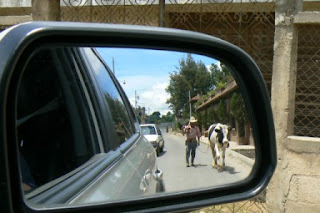
Thursday morning I turned my parents loose in Antigua as I drove to the Healing Waters/Aguas de Unidad Guatemala office. Thursday was another full, but very fulfilling day. I arrived at the office and got caught up on e-mail, staying in touch with the Denver office of Healing Waters. Then Juan, Dani and I piled into the car and drove to Comalapa, a city of 15,000 that is about 1 hour from the office. Along the way we shared the road with a man herding his cow as you can see in the photo below.
We are installing a new water system in Comalapa this year, so I got the chance to see where the water system is being installed and learn a little bit more about the community. I am really excited about this water system because it is being installed in a Christian school that has representation from various churches in town, including Catholic and Protestant. The school is run by an interdenominational organization with a strong version for serving their community.
 This is a photo of me standing in front of the school with a teacher
 A Catholic church, a brightly painted bus and a "tuk-tuk" (three wheeled motorcycle taxi)
 Three boys in the market who wanted me to take their photo
 An indigenous woman selling tomatos and potatos
 A beautiful indigenous woman selling flowers
 The woman preparing the corn and cutting the limes
 Me enjoying some roasted corn on the cob
 The pastor and elders of the church, note a slight difference in height.
After that meeting, we headed to a famous Chinese restaurant in Guatemala city (I know, Chinese food it Guatemala? Right?) The food was mediocre but the meeting with the pastor went well. He had some good feedback and suggestions and really enjoyed getting to know him and hear about his church. Guatemala is a country of contrasts, and this man is the co-pastor of a church. He is well-educated and from a middle class family. His co-pastor at the church is a carpenter with a 6th grade education. It was amazing to learn how well these two men complement each other and can do such a great job leading a church.
 Important Healing Waters/Aguas de Unidad and church business over Guatemalan Chinese food!
 Another substantial height difference. Next to me is Daniela Rosales, a Healing Waters/Aguas de Unidad staff member in Guatemala
 Gregorio and Juan Orlando
 Cristobal blowing out his candles


 My Dad and I at the Mirador overlooking Lake Atitlan and Panajachel
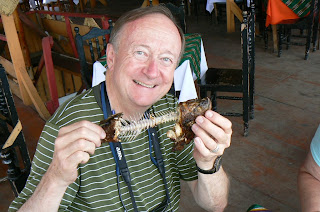 Dad after finishing his Mojarra. I told him to eat the eyes, he wasn't interested.
Thursday morning I turned my parents loose in Antigua as I drove to the Healing Waters/Aguas de Unidad Guatemala office. Thursday was another full, but very fulfilling day. I arrived at the office and got caught up on e-mail, staying in touch with the Denver office of Healing Waters. Then Juan, Dani and I piled into the car and drove to Comalapa, a city of 15,000 that is about 1 hour from the office. Along the way we shared the road with a man herding his cow as you can see in the photo below.

We are installing a new water system in Comalapa this year, so I got the chance to see where the water system is being installed and learn a little bit more about the community. I am really excited about this water system because it is being installed in a Christian school that has representation from various churches in town, including Catholic and Protestant. The school is run by an interdenominational organization with a strong version for serving their community.
 This is a photo of me standing in front of the school with a teacher
After visiting the school where the water system will be installed and meeting with some people from the school, Juan, Dani and I toured the local market where I got to take some great photos.
 A Catholic church, a brightly painted bus and a "tuk-tuk" (three wheeled motorcycle taxi)
 Three boys in the market who wanted me to take their photo
 An indigenous woman selling tomatos and potatos
 A beautiful indigenous woman selling flowers
 On our way back to the office we stopped by a roadside stand where they sell roasted corn on the cob. You rub lime and salt on the corn and it is DELICIOUS!
 The woman preparing the corn and cutting the limes
 Me enjoying some roasted corn on the cob
 We got back to the office in time to finalize our schedule for the next day, which included a morning meeting with a couple of my staff members, and visits with three church partners all over Guatemala city. Friday morning dawned early once again, as I had to meet with Ben, our tech and maintenance manager to help him with contracting an assistant. Then we hopped in the car and headed into Guatemala city. I met with the pastor a two church elders from a church that is really involved in their community. We met on the campus of a seminary where the pastor teaches classes.
 The pastor and elders of the church, note a slight difference in height.
 After that meeting, we headed to a famous Chinese restaurant in Guatemala city (I know, Chinese food it Guatemala? Right?) The food was mediocre but the meeting with the pastor went well. He had some good feedback and suggestions and really enjoyed getting to know him and hear about his church. Guatemala is a country of contrasts, and this man is the co-pastor of a church. He is well-educated and from a middle class family. His co-pastor at the church is a carpenter with a 6th grade education. It was amazing to learn how well these two men complement each other and can do such a great job leading a church.
 Important Healing Waters/Aguas de Unidad and church business over Guatemalan Chinese food!
My final meeting of the day was in the Santa Fe neighborhood which is literally a stones-throw away from the runway of the Guatemala City International Airport. This neighborhood is famous because every few years a pilot doesn't stick the landing at the airport, or the brakes don't work on the plane and the planes end up crashing into this neighborhood. (I guess that is not something you want to be famous for.) The pastor of the church had a great sense of humor and a huge heart for serving his community. It was very clear that he was using the Healing Waters system to reach out to his community and provide them a source of safe drinking water. . . and hope for a better future.
 Another substantial height difference. Next to me is Daniela Rosales, a Healing Waters/Aguas de Unidad staff member in Guatemala
We finally made it back to the office at about 5pm and celebrated the birthday of Cristobal, one of the employees at the Aguas de Unidad Guatemala office. Our Guatemalan accountant, Letty, has a one year old son that joined us for the party. After some delicious cake, I took the time to say goodbye and pray with the employees. It was a long but very fulfilling work-week.
 Gregorio and Juan Orlando
 Cristobal blowing out his candles
I drove back to Antigua exhausted but very content. My parents were waiting for me and we all went to dinner at Mono Loco and had their famous nachos! On Saturday morning my parents and I drove to Lake Atitlan. It is a beautiful lake in the Guatemalan highlands surrounded by two huge volcanoes. We walked through the market and I started to buy dresses for my daughter (who will be born on December 20th.) I went a little crazy and ended up getting 7 different dresses, but it was fun!

Then we took a boat ride out on the lake to a small village. We returned to Panajachel (the major city on the lake) and had a delicious lunch of Mojarra, a fish that is caught in Lake Atitlan.


 My Dad and I at the Mirador overlooking Lake Atitlan and Panajachel
 Dad after finishing his Mojarra. I told him to eat the eyes, he wasn't interested.
 We drove back to Antigua and then met Juan Colmenares (a Guatemala Aguas de Unidad employee) and his family for our final dinner in Guatemala.
On Sunday morning we left our hotel in Antigua at 6:00am to be at the bus terminal in Guatemala city at 7am. Our bus left for Tapachula at 7:30am and arrived in Tapachula at 2:00pm. Tapachula is just across the Mexican border in southern Chiapas.
The border crossing was a little bit chaotic. The bus dropped us off on the Guatemalan side of the border where we had to wade through money changers and people offering to "help us" with the immigration process. Once we got up to the window for Guatemalan immigration, they looked at our passports and told us we had to pay 10 Quetzales each (the equivalent of $1.25.) I was suspicious of that as I didn't think there was an "exit tax" to leave the country so I asked the agent if she could produce a receipt for me. Surprise, Surprise, their machine was broken so she couldn't give me a receipt. But if I wanted to go to the bank a block away and make the payment there, they would give me a receipt. The bank had a line out the door and I decided it would be easier to just pay and get across the border. After that you physically walk across a bridge that is the Guatemala-Mexico border. On the other side the bus is waiting. You take your bags from underneath the bus and then go through Mexican immigration and customs. We put the bags back on the bus, borded and off we went.
From the border to Tapachula it is about 30 minutes and we got stopped at police/military checkpoints twice looking for drugs and illegal immigrants.
We got the bus station in Tapachula which was surprisingly clean and calm for a Latin American bus station. We had to wait for an hour and a half to get our bus to Tuxtla so I ran out and bought some sandwiches, chips and soda.
We boarded the bus to Tuxtla at 3:30pm and finally made it to Tuxtla at 9:30pm. Once again there were at least 4 military/police checkpoints looking for drugs and illegal immigrants.
We checked into our hotel and then went over to Mario's house. He is the National Director of Healing Waters/Aguas de Unidad Mexico. Mario's wife, Kim, is an INCREDIBLE cook and she had made some typical dishes for us. In typical fashion, dinner lasted until midnight and we finally made it back to the hotel and crashed.
Now I am Mexico for the week and will try to post updates a little more frequently. My schedule will slow down a bit, so I hope to be sharing a bit more. Thanks for reading and LET THE CLEAN WATERS FLOW!
Wednesday, July 29, 2009
Saludos de Guatemala! (Greetings from Guatemala!)
 This is the daughter and granddaughter of Esther, the recipient of the Habitat for Humanity House that the Wellshire group built in March. I had a chance to go back and visit the family and see their completed house. You can read more below.
I am sitting down relaxing in the lobby of my little hotel in Antigua for the first time since I arrived on Sunday night. I finally have a little free time to sit down and update my blog, so here goes!
I am spending a week in Guatemala and a week in Mexico working with the local staff and offices of Aguas de Unidad/Healing Waters International. I arrived here in Guatemala late Sunday night and will be catching a bus to Mexico this Sunday. For my seven days here in Guatemala, I have a pretty packed itinerary.
After my plane landed at 11pm on Sunday, Daniela Rosales from our Guatemala office picked me up at the airport and we made the 45 minute long drive to Antigua (this drive takes only 45 minutes when there is no traffic, more on that later.) She dropped me off at the hotel and I crashed. I woke up Monday morning at 5:15am to shower, get dressed and be ready to go at 5:45am. I had a meeting planned with a member of the Aguas de Unidad Guatemala board of directors at 7:30am in Guatemala city and because of the rush hour traffic, it takes an hour and a half to get from Antigua to Guatemala City in the mornings.
The meeting was very successful. I had the chance to thank our board member for his service to the organization, update him on what was going on with Healing Waters and he shared some great ideas and thought that he had about how to make Aguas de Unidad better in Guatemala.
After this meeting, I drove to our office (which is on the road between Guatemala City and Antigua.) I held a staff meeting with all of our Guatemala staff, got brought up to speed on the happenings of the Guatemala office, helped establish and set some priorities, and enjoyed some quality time with our amazing Guatemala Aguas de Unidad team.
After a delicious lunch, I headed to one of our water systems that is located with a church in the "La Florida" neighborhood. I sat down with the pastor of the church and talked through some operational changes that we have while getting updated on how the water system was going for his church. The opportunity to be in the field seeing the water systems and meeting with the pastors is always amazing and really recharges my batteries in the work that I do for Healing Waters/Aguas de Unidad.
This pastor has been using the water system to bless his neighborhood and his church, and it was amazing to see the love in his eyes for Jesus and for his community. After the meeting at the water system in La Florida, I headed back to the office and spent an hour working with Ben, our director of maintenance for Guatemala.
We are in the process of hiring an assistant for Ben and he and I had to sit down and write the job description and employment contract. While this may sound dry and boring, it was also an opportunity to get caught up with Ben. I have talked about him before in my blog: http://blogadegregorio.blogspot.com/2009/06/day-in-life-of-healing-waters-field.html He is a great guy and it was a lot of fun to work with him, even on a project that might seem boring.
After we wrapped up at 6:30pm, we headed back to Antigua. These 10-13 hour work days can be long when I am in the field, but they are worth it. Because my plane ticket and hotel are paid for by our generous donors, I really feel like I need to be a good steward of those donations and take full advantage of my time in the field, so I tend to work very long but very fulfilling days.
When I got back to Antigua, I went out for tacos with Dani, Ben and Ben's wife Krista. We shared some great stories over some Gallo beers and tacos. All in all, it was a great day in the field!
On Tuesday morning, I had to get up at 5:15am again for a 5:45am departure to Guatemala city. I went to meet with the national denominational council for the "Verbo" churches, which is a big denomination of evangelical churches that started here in Guatemala. The denomination has over 30 churches here, and many in other countries including Ecuador, El Salvador, Honduras, Nicaragua and they have even planted churches in Spain, Canada and the United States. I love this sort of "reverse missionary" work when Latin America is sending missionaries to do church planting in "developed" countries like Canada, the United States and Europe. It turns the whole missionary perspective on its head and I just love it!
The meeting with the denominational leadership for the Verbo churches went very well, far better than expected. We have 2 water systems currently at Verbo churches, and after this meeting with their national council, I hope we will consider expanding into more Verbo churches in the future.
We headed back to the office and then I took our whole ADU Guatemala staff out to lunch. After a delicious lunch, I headed to the community of Villa Verde in Ciudad Quetzal. This is where we are going to be installing one of our next water systems. I had the chance to meet with some members of the church, tour the community and see the location where the water system will be installed.
It is very exciting that despite the tough economic times, Healing Waters/Aguas de Unidad is still expanding as an organization and we will be installing three new water systems in Guatemala this year. (Along with 3-4 in Mexico and 10 in the Dominican Republic.) I hope to visit one of the other new water system sites later in the week.
I returned to the office late in the afternoon and then called our headquarters in Denver to check in and update everyone there and finally made it back to my hotel at about 6:30pm, racking up another 12+ hour day but excited both for what was accomplished and for what the rest of the week held in store.
Wednesday morning (this morning) I actually got to sleep in until 6:30am, imagine that! My first meeting was an 8am breakfast meeting with a pastor, but it was in a town between Antigua and Guatemala city, so I didn't have to fight the rush-hour traffic going into Guatemala City.
The meeting with the pastor was incredible. He told me stories of some of the amazing things happening at his church, at the water system and in the community. This is one of those pastors that just knocks your socks off with his vision for serving his community and his amazing work ethic.
We departed the breakfast meeting to go to Chimaltenango, which is a town about 30 minutes from Antigua where we have two water systems. This is the town where we went with the group from Wellshire Presbyterian church for a trip in March.
We arrived about 30 minutes early, so we drove to the Habitat for Humanity house that the group from Wellshire helped to build back in March. I had the chance to see the completed house and spend a few minutes talking with the family, it was great to see the project come to completion and see the family moved into their house. I really respect organizations like Habitat for Humanity because they provide such a basic thing (dignified housing) but really work to empower the recipients of the houses and charge no interest or very low interest loans to the new homeowners, truly a "hand up" and not a "hand out."
 After visiting with Esther (the new homeowner) we headed to one of the churches in Chimaltenango where we have a water system. We met with the pastor for over two hours, and got an update on the state of the water system and the church. Once again the pastor shared some great stories about what they have been able to do in their community because of the water system. It was invigorating!
After a quick lunch, we met with the other pastor at the other church in Chimaltenango that has a Healing Waters/Aguas de Unidad system. I hadn't met this pastor before and it was great to sit and talk with him and hear his vision for transforming his community.
We returned to the office at about 4:30pm and I checked back in with the Denver office and got caught up on e-mails. After leaving the office at 6pm, I have been sitting in the hotel relaxing.
I am going to go grab some dinner and then drive down to Guatemala City to pick up my parents who come in on a flight tonight.
They are going to hang out here in Guatemala for the next few days while I am working and then join me on the bus trip from Guatemala to Chiapas, Mexico on Sunday. I am blessed to have them come down here to spend some time with me, enjoy all that Antigua has to offer and keep me company in the 12 hour bus ride on Sunday.
I will try to update once or twice more before I leave for Mexico on Sunday. I will also try to get some more photos in here too. Take care and LET THE CLEAN WATERS FLOW!
Thursday, July 16, 2009
Guest Blogger: Great blog post from a good friend about missions work
So I haven't been great about getting new content on my blog this month. It has been a crazy few weeks, and I just haven't felt inspired. . . until this morning.
I read a blog post from a friend of mine and wanted to repost it. I think it is profound enough that it needs to get some circulation. The "Guest Blogger" today is Paul Sundberg, who is a Lutheran pastor up in Lynwood, Washington. His daughter, Kirsten, and son-in-law, Nathan, are some of our best friends and I count Paul as a friend of mine in his own right.
The post really resonated with me relative to the work I do with Healing Waters and any other global or local missions work that people do. Enjoy!
Tuesday, July 14, 2009
Are We Just Enabling?
So here is the question-- We do a whole lot of local mission work, helping those who are homeless, have little in the way of resources or money. Jesus teaches us to take care of those-- feed the hungry, etc. When people have made a whole host of poor decisions that have landed them in that spot, are we doing more to enable them to make more poor decisions, or are we really doing good? There are consequences to our decisions--where do these come in? In this culture of kindness and gospel outreach, I feel guilty even asking the question-- but it has been bothering me for months. And maybe it's grace. We don't judge-- we just do what we can and leave the rest to the Lord. Comments?
This is a question with which we constantly struggle as we work to address basic needs. There simply aren’t simple answers.
It is an accurate reading of the gospels to conclude that Jesus never asked someone how they got into a situation of need. It is also an accurate reading to conclude that much of Jesus’ criticism of the Pharisees, scribes, priests, and leaders is directed to their socio-economic/political failure to care for the poor and excluded. Such care was an obligation of the “system”/institutions. When it comes to personal choices Jesus seems to point to the reality that systems themselves limit the range of choices one can make. What is possible from one position in the system is impossible from another position in the system.
Maybe the most interesting situations occur with the feeding of the great crowds 5000 and 4000 “not counting women and children”. These people willingly followed Jesus out into the desert and seem to have neglected to provide for their own needs – generally accepted foolish behavior. In addition, it’s likely that few would have suffered by waiting for a meal until they got back home. But, Jesus says, “feed them”.
It’s not that Jesus doesn’t call us to exercise our decision making abilities; he just doesn’t call us to self care. When he feeds and heals he sends people back home to take up their productive/supportive roles in society. When he doesn’t do that he invites people to follow him and join his community – and become healers and feeders of those in need. There is nothing he does about past choices; he only draws people into new opportunities. And what if their choices are once again bad? 70 X 7 seems to be the formula for forgiveness – transformation most often takes a long time.
So, meeting basic needs seems to have several objectives. 1) Meet the need, after all, hungry is hungry, thirsty is thirsty, homeless is homeless. 2) Draw people into community. 3) Turn the healed and fed into healers and feeders of others.
Those are the objectives we actively pursue at Trinity as we deal with basic needs. Thanks be to God, we’re seeing all three of them realized.
Posted by paul sundberg - justkeepasking@gmail.com at 6:34 AM
Labels: care, choice, community, Compassion, forgiveness
I read a blog post from a friend of mine and wanted to repost it. I think it is profound enough that it needs to get some circulation. The "Guest Blogger" today is Paul Sundberg, who is a Lutheran pastor up in Lynwood, Washington. His daughter, Kirsten, and son-in-law, Nathan, are some of our best friends and I count Paul as a friend of mine in his own right.
The post really resonated with me relative to the work I do with Healing Waters and any other global or local missions work that people do. Enjoy!
Tuesday, July 14, 2009
Are We Just Enabling?
So here is the question-- We do a whole lot of local mission work, helping those who are homeless, have little in the way of resources or money. Jesus teaches us to take care of those-- feed the hungry, etc. When people have made a whole host of poor decisions that have landed them in that spot, are we doing more to enable them to make more poor decisions, or are we really doing good? There are consequences to our decisions--where do these come in? In this culture of kindness and gospel outreach, I feel guilty even asking the question-- but it has been bothering me for months. And maybe it's grace. We don't judge-- we just do what we can and leave the rest to the Lord. Comments?
This is a question with which we constantly struggle as we work to address basic needs. There simply aren’t simple answers.
It is an accurate reading of the gospels to conclude that Jesus never asked someone how they got into a situation of need. It is also an accurate reading to conclude that much of Jesus’ criticism of the Pharisees, scribes, priests, and leaders is directed to their socio-economic/political failure to care for the poor and excluded. Such care was an obligation of the “system”/institutions. When it comes to personal choices Jesus seems to point to the reality that systems themselves limit the range of choices one can make. What is possible from one position in the system is impossible from another position in the system.
Maybe the most interesting situations occur with the feeding of the great crowds 5000 and 4000 “not counting women and children”. These people willingly followed Jesus out into the desert and seem to have neglected to provide for their own needs – generally accepted foolish behavior. In addition, it’s likely that few would have suffered by waiting for a meal until they got back home. But, Jesus says, “feed them”.
It’s not that Jesus doesn’t call us to exercise our decision making abilities; he just doesn’t call us to self care. When he feeds and heals he sends people back home to take up their productive/supportive roles in society. When he doesn’t do that he invites people to follow him and join his community – and become healers and feeders of those in need. There is nothing he does about past choices; he only draws people into new opportunities. And what if their choices are once again bad? 70 X 7 seems to be the formula for forgiveness – transformation most often takes a long time.
So, meeting basic needs seems to have several objectives. 1) Meet the need, after all, hungry is hungry, thirsty is thirsty, homeless is homeless. 2) Draw people into community. 3) Turn the healed and fed into healers and feeders of others.
Those are the objectives we actively pursue at Trinity as we deal with basic needs. Thanks be to God, we’re seeing all three of them realized.
Posted by paul sundberg - justkeepasking@gmail.com at 6:34 AM
Labels: care, choice, community, Compassion, forgiveness
Tuesday, June 30, 2009
One more Wellshire team Guatemala Sermonette/Message
 Rachel is in the green shirt on the far left
 Below is the final sermonette/message from one of the members of Wellshire who participated in the Healing Waters/Habitat mission trip to Guatemala in March of 2009. It focuses on our responsibility as Christians to ensure that the money we give to causes is being used wisely, good stewardship. This was written by Rachel Wildrick, a member of Wellshire and sophomore at UC Boulder. Enjoy!
After my first year of college, the thing I’ve begun to get my head around most is the simple fact that life isn’t that simple. It isn’t just the sky is blue, as anyone familiar with the physics of light and refraction could tell you. Life requires considering all sorts of different data and interaction. In a similar way, ADU Guatemala has changed the way I view charity- no longer is it we give, they receive – too simple! Instead, charity is about not only meeting needs, but also meeting needs in a compassionate, yet helpful manner – we don’t just give, we help empower and help up our brothers and sisters… and that means giving with more than just that particular need in mind. It is the nonprofits that take into account the issues or problems that a situation presents (in other words, are a little more complicated to explain) that are the successful, effective, working organizations.
For example, ADU’s partnerships with good-standing, local churches who have seen a need and want to help meet it give the churches the opportunity to stimulate the area’s local economy (by employing locals and charging a fair price for water), and to also use the portion of whatever profit they make to help grow and lift up the community around them. On our trip there, that meant that we went to local schools and painted classrooms, took class pictures, and played with the children all in the name of the church we were working with.
At the local high school, the very idea of community service by others inspired a celebration for the entire school, involving a full-fledged banquet, gifts for us made by the shop class and a dance performance – this fabulous celebration was really a celebration of the outreach and the impact that this church was able to make on the school. Made possible BY ADU, and through ADU’s holistic approach, and their encouragement of serving the community through something like a small profit through selling clean, disease free water for a manageable and fair price makes a huge difference in the people in that area. I remember someone remarking after we left that day from the school, that this day is something that they will remember forever (whether it be just the image of white tall gringos attempting to challenge their star basketball team or us painting the inside and outside of their school, not only are the memories stamped on our hearts, but we have made an indelible mark on their lives as well.
It’s giving with knowledge and understanding of what you’re giving to… No longer will I give money or time to organizations who are giving handouts that don’t work for long… ADU sets the standard for empowering those that they serve, thoughtfully and with a mind to better the community. I obviously have a very high opinion of ADU, and think that they set the standard in many ways for non profit organizations, but one thing that is crucial to conscientious giving is the accountability of the organization. By keeping close record of all water sales, they are setting an example of good business and accountable habits for the churches they work with and the local employees, which as we’ve talked about, reaches the entire community.
In our giving to organizations that are accountable and effective, we in turn are being effective givers, where our time and money really count and make a difference. With the old ideas of simple donation (we give they receive) out the window, I want to suggest that giving is more about the Christian ideals like giving somebody the tools that will help them up, accountability to the community and to God, as well as giving back to the community that you live and work in.
It’s harder and more complicated to consider things like economy, business, community development, but I feel as though God calls us to consider the bigger issues, to consider the difficult things. God’s not about a temporary fix or handing out 500 dollars that’ll run out in no time. God is about solving long term problems with long term solutions. So while it may take an additional 15 minutes to describe, really, what your favorite charity does, I think it might just maybe be more of what God wants from our charity. Not just simple giving, but thoughtful, compassionate giving that addresses the problems, whether they be monumental or easily fixed.
Yes, the sky is blue… but give me 15 minutes and I could tell you the million different reasons and interacting sciences that make it work.
Monday, June 22, 2009
Another Sermonette/Message from the Wellshire Guatemala Team
I am going to share a couple more of these sermonettes because they really drive home the power of Global Missions and the important work of organizations like Habitat for Humanity and Healing Waters International.
This one is from Ray Johnson. Ray has been a member of Wellshire for decades and he went on this trip with his whole family (wife and two kids.) The message is pretty self-explanatory, so enjoy!
WHY GUATEMALA?
Good morning. My name is Ray Johnson, and I had the privilege of being part of Wellshire’s recent trip to Guatemala. I have to be honest. The main reason I went on the trip to Guatemala is that my wife told me I had to. She really wanted our family to participate together in an international mission trip ... and it was a great idea. But, I had two questions prior to this trip that made me hesitant about doing an international trip:
The first was “Why Guatemala?” Why travel all that distance to another country when you can find many of the same problems we are going there to address, right down the street in our own city? This is a question I asked myself and it is a question I was repeatedly asked by others.
That question was answered for me while I was in Guatemala. See, there are approximately 13,000,000 Guatemalans … of those, approximately 1,000,000 are presently living in the United States, some legally, some illegally, seeking a better life for themselves and their families. They are here hoping to work and be able to send money back to their families so that their lives can be better in Guatemala. And Guatemala is just one country where this is happening.
I also learned that drug and gang violence was on the rise in Guatemala. I learned that many of the gang leaders there were “trained” in Los Angeles gangs and were deported back to Guatemala after they had been arrested. Back in Guatemala, they’ve carried on with what they know.
When you travel to a country like Guatemala, or any other country for that matter, and you listen to the people there, you realize that no matter how different we look, or what language we speak, or what our customs or living standards are, God created us all the same. We all need food and shelter, we want to love and laugh, we want a safe place to raise our families, and the list of similarities goes on. In short, they desire the very things that we desire.
So, I truly believe that a man in Guatemala, given the hope of decent housing, clean water and an education for his children would rather stay with his family in his native land than travel to the United States in hopes of being able to send some money back to make the lives of his family better in his absence.
So what occurred to me on this trip is that maybe, just maybe, some of the problems occurring right down the street here in Denver and in other cities in our nation are truly global problems that need a global solution; a global solution that starts by providing hope for people in nations like Guatemala.
The second question that kept gnawing at me prior to this trip was “can we really hope to make a difference?” After all, I just told you that there are 13,000,000 Guatemalans and 19 of us who traveled down there for one week. We talked about this after we arrived in Guatemala. Greg Allen-Pickett told a story that I had heard before, but had forgotten. I won’t forget it again.
The story is about a young boy walking along a beach. The beach is littered with thousands of starfish that had been washed up on the beach in a storm the night before. As you know, starfish don’t move very fast, and their chance of making it back to the water before the sun rose and killed them was slim. So the young boy was picking them up one by one and casting them back into the water. A man came along and asked the boy; what are you doing? There are starfish along this beach for as far as you can see in both directions (maybe 13,000,000 of them)… you can’t possibly make a difference! The boy bent over, picked up another starfish, cast it into the water, looked at the man and said, “I made a difference to that one!”
So now when I think about the 19 of us traveling to Guatemala and working for four days on a Habitat for Humanity house for a woman named Ester, I can’t help but think “we made a difference to that one”… A difference that will impact her, her daughters and her grand children and maybe provide that glimmer of hope.
So next time you hear that Wellshire is planning a global mission trip, don’t be like I was. Remember two things: 1. We really have become a global society that needs global solutions, and 2. Don’t be paralyzed into inactivity, globally or locally, by thinking, I can’t possibly make a difference.
This one is from Ray Johnson. Ray has been a member of Wellshire for decades and he went on this trip with his whole family (wife and two kids.) The message is pretty self-explanatory, so enjoy!
WHY GUATEMALA?
Good morning. My name is Ray Johnson, and I had the privilege of being part of Wellshire’s recent trip to Guatemala. I have to be honest. The main reason I went on the trip to Guatemala is that my wife told me I had to. She really wanted our family to participate together in an international mission trip ... and it was a great idea. But, I had two questions prior to this trip that made me hesitant about doing an international trip:
The first was “Why Guatemala?” Why travel all that distance to another country when you can find many of the same problems we are going there to address, right down the street in our own city? This is a question I asked myself and it is a question I was repeatedly asked by others.
That question was answered for me while I was in Guatemala. See, there are approximately 13,000,000 Guatemalans … of those, approximately 1,000,000 are presently living in the United States, some legally, some illegally, seeking a better life for themselves and their families. They are here hoping to work and be able to send money back to their families so that their lives can be better in Guatemala. And Guatemala is just one country where this is happening.
I also learned that drug and gang violence was on the rise in Guatemala. I learned that many of the gang leaders there were “trained” in Los Angeles gangs and were deported back to Guatemala after they had been arrested. Back in Guatemala, they’ve carried on with what they know.
When you travel to a country like Guatemala, or any other country for that matter, and you listen to the people there, you realize that no matter how different we look, or what language we speak, or what our customs or living standards are, God created us all the same. We all need food and shelter, we want to love and laugh, we want a safe place to raise our families, and the list of similarities goes on. In short, they desire the very things that we desire.
So, I truly believe that a man in Guatemala, given the hope of decent housing, clean water and an education for his children would rather stay with his family in his native land than travel to the United States in hopes of being able to send some money back to make the lives of his family better in his absence.
So what occurred to me on this trip is that maybe, just maybe, some of the problems occurring right down the street here in Denver and in other cities in our nation are truly global problems that need a global solution; a global solution that starts by providing hope for people in nations like Guatemala.
The second question that kept gnawing at me prior to this trip was “can we really hope to make a difference?” After all, I just told you that there are 13,000,000 Guatemalans and 19 of us who traveled down there for one week. We talked about this after we arrived in Guatemala. Greg Allen-Pickett told a story that I had heard before, but had forgotten. I won’t forget it again.
The story is about a young boy walking along a beach. The beach is littered with thousands of starfish that had been washed up on the beach in a storm the night before. As you know, starfish don’t move very fast, and their chance of making it back to the water before the sun rose and killed them was slim. So the young boy was picking them up one by one and casting them back into the water. A man came along and asked the boy; what are you doing? There are starfish along this beach for as far as you can see in both directions (maybe 13,000,000 of them)… you can’t possibly make a difference! The boy bent over, picked up another starfish, cast it into the water, looked at the man and said, “I made a difference to that one!”
So now when I think about the 19 of us traveling to Guatemala and working for four days on a Habitat for Humanity house for a woman named Ester, I can’t help but think “we made a difference to that one”… A difference that will impact her, her daughters and her grand children and maybe provide that glimmer of hope.
So next time you hear that Wellshire is planning a global mission trip, don’t be like I was. Remember two things: 1. We really have become a global society that needs global solutions, and 2. Don’t be paralyzed into inactivity, globally or locally, by thinking, I can’t possibly make a difference.
Wednesday, June 17, 2009
Another Sermonette/Message from the Wellshire Guatemala Team
On Sunday, June 7th, Wellshire Presbyterian Church celebrated the Global Missions Trip to Guatemala with Healing Waters International and Habitat for Humanity. My last post was the sermon/message/homily that I gave at the service. Below is another one from Ted Griffith. This was Ted's first foray into Global Missions, and I think he is hooked. Enjoy and THANKS TED!
My name is Ted Griffith….my wife & I moved here April a year ago. Thank you all for your warm welcome & acceptance. Do you remember when you went home (the home you grew up in) after an extended absence……… That is the feeling you give me.
We are set apart for service to one another.
Everyone should experience international & domestic mission work. Those who are not able can sponsor someone & experience through them the satisfaction of mission service.
We are likely to consider ourselves middle class or above. By American standards our assessment may be accurate, but by global standards we are incredibly rich. .
I believe in a hand up not a hand out & that is exactly what Habitat For Humanity & Healing Waters International preaches.
I like to physically see progress like cinder blocks being laid, concrete being mixed & water being purified & distributed.
But to get involved in relationships with fellow workers, Ester, school kids takes me to a different emotional level.
When we see another as God’s anointed, our relationships are profoundly affected.
That is what this mission trip did for me.
We are set apart for service to one another.
Santos & Pedro were masons employed by Habitat For Humanity making a combined income of $200 per house, to pour the foundation, lay cinder block, install the roof, & pour the concrete floor…... With help they can complete a house in 15 days (& most of the time they don’t have help). (10 hr days …. do the math …. that’s $ .67 per hour)
Santos (recently married) & Pedro (Santos’ brother in law) worked hard, had a great sense of humor & their faith in God was very genuine. They live 2 ½ hours away so they slept in the tool shed during the week & cooked meals over a wood fire.
A neighbor at the Habitat site, unannounced, fed all of us that were there. (beans, corn & tortillas prepared over a wood fire).
A family invited all 19 of us for a meal, it was prepared over a wood fire
Propane, gas, or electricity is too expensive & not readily available.
What little they have they are so willing to share.
We are set apart for service to one another
When you come back from a mission trip you have flash backs & emotional swings at odd times.
I have laughed out loud (when I think of Brian or Graham waking me up – my travel alarm has a soft tone without my hearing aids, but it was annoying to Brian & Graham in the next room, or the van struggling to get up a hill, or the flat tire on the way to the airport) & also being awestruck by the Guatemala children, youth, & adults for their zest for life, their smiles, their laughter, their music, their worship service, & their love of God.
They have so little by our standards yet they really have so much.
The Monday after we returned I was fixing an egg for breakfast…….cracked an egg into a plastic dish, put it in the microwave, pushed the right buttons……..
All I saw was food cooking over a wood fire, smoke and all…..
Tears started to flow.
We all are set apart for service to one another.
My name is Ted Griffith….my wife & I moved here April a year ago. Thank you all for your warm welcome & acceptance. Do you remember when you went home (the home you grew up in) after an extended absence……… That is the feeling you give me.
We are set apart for service to one another.
Everyone should experience international & domestic mission work. Those who are not able can sponsor someone & experience through them the satisfaction of mission service.
We are likely to consider ourselves middle class or above. By American standards our assessment may be accurate, but by global standards we are incredibly rich. .
I believe in a hand up not a hand out & that is exactly what Habitat For Humanity & Healing Waters International preaches.
I like to physically see progress like cinder blocks being laid, concrete being mixed & water being purified & distributed.
But to get involved in relationships with fellow workers, Ester, school kids takes me to a different emotional level.
When we see another as God’s anointed, our relationships are profoundly affected.
That is what this mission trip did for me.
We are set apart for service to one another.
Santos & Pedro were masons employed by Habitat For Humanity making a combined income of $200 per house, to pour the foundation, lay cinder block, install the roof, & pour the concrete floor…... With help they can complete a house in 15 days (& most of the time they don’t have help). (10 hr days …. do the math …. that’s $ .67 per hour)
Santos (recently married) & Pedro (Santos’ brother in law) worked hard, had a great sense of humor & their faith in God was very genuine. They live 2 ½ hours away so they slept in the tool shed during the week & cooked meals over a wood fire.
A neighbor at the Habitat site, unannounced, fed all of us that were there. (beans, corn & tortillas prepared over a wood fire).
A family invited all 19 of us for a meal, it was prepared over a wood fire
Propane, gas, or electricity is too expensive & not readily available.
What little they have they are so willing to share.
We are set apart for service to one another
When you come back from a mission trip you have flash backs & emotional swings at odd times.
I have laughed out loud (when I think of Brian or Graham waking me up – my travel alarm has a soft tone without my hearing aids, but it was annoying to Brian & Graham in the next room, or the van struggling to get up a hill, or the flat tire on the way to the airport) & also being awestruck by the Guatemala children, youth, & adults for their zest for life, their smiles, their laughter, their music, their worship service, & their love of God.
They have so little by our standards yet they really have so much.
The Monday after we returned I was fixing an egg for breakfast…….cracked an egg into a plastic dish, put it in the microwave, pushed the right buttons……..
All I saw was food cooking over a wood fire, smoke and all…..
Tears started to flow.
We all are set apart for service to one another.
Thursday, June 11, 2009
Guatemala and Global Drinking Water Crisis Message
Last Sunday my church celebrated our mission trip to Guatemala. Seven members of our mission team gave short messages/sermonettes/homilies to share our experience in Guatemala with the rest of Wellshire church. Below is the message I gave, which sort of expounded on the bible study that I led the last day our group was in Guatemala. . . enjoy!
How many of you have had the opportunity and privilege of traveling to Mexico or Guatemala?
How many of you were given the advice “Don’t drink the water?”
Many people believe that advice is just for Americans and that the locals can drink their own tap water.
The sad reality is that is simply not the case. In 90% of cities in Mexico, Guatemala and the Dominican Republic, the tap water that comes out of the tap is so contaminated it would make anyone sick, no matter what your nationality. You see little bugs like salmonella, giardia, fecal coliforms, e coli and others don’t discriminate based on your nationality, anyone who comes in to contact with these little buggers gets sick.
That is a daily reality for the people that live in Guatemala and other developing countries, they can’t just go to the tap and get a glass of drinking water and they have to treat any water they are going to cook with too.

Some facts about the global drinking water crisis:

-More than 1.1 billion people in the world, 1 in 6, lack access to safe drinking water
 -More than 1.5 million children under the age of 5 die from water borne illnesses each year, like the equivalent of 16 Boeing jumbo jets crashing each day, no survivors.
 -Diarrhea from water borne disease is the second leading cause of mortality among children.
 -Poor, urban communities of the developing world pay the highest prices in the world for water.
 These are numbers. Numbers and statistics are important for us to try to understand the depth and breadth of a problem, but numbers never tell the whole story.
 These numbers have faces, and we had the privilege of looking in those faces each day we were in Guatemala. Many of those faces are the photos I took on the trip in this blog post.
 But our trip to Guatemala was not a story of sadness, it was a story of hope, because each one of us who went on the trip to Guatemala and each one of you who prayed for us while we were on the trip. . .
 is working to change these numbers and just as important, looking in these faces and building relationships and solidarity with the people that represent these statistics.
 As Christians, we are called to help others in the world who are hurting, struggling and not getting their basic needs met. We are called LOUDLY to do this throughout scripture.
 In Matthew 25, Jesus states “. . . for I was hungry and you gave me food, I was thirsty and you gave me something to drink, I was a stranger and you welcomed me, I was naked and you gave me clothing, I was sick and you took care of me. . .
 Truly I tell you, just at you did it to one of the least of these who are members of my family, you did it to me.”
 I have felt this call strongly in my life and it has led me to do development work in Latin America as the Field Operations Manager for Healing Waters International.
 Each person will respond this call differently, by helping out a neighbor, by working in the soup kitchen or homeless shelter down the street, by traveling to a native American reservation and working there, or by doing global missions.
 Each one of these are equally important and equally good responses to that call, but it is so important that we heed that call and like Jesus, actively work to feed the hungry, offer drink to the thirsty, comfort to the lonely, care to the sick.
 We could learn statistics about all of these hurting people in our world, and statistics are important to grasp the scope of a problem, like the global problem for safe drinking water.
 But we also need to remember that these numbers have faces.
 We need to look in those faces and shine the light of Christ through our eyes and treat those in need with the dignity, respect and help that Christ is calling us to do.
 So all of this really begs the question: What are you going to do to heed that call?
 This is your call to action. In Healing Waters when talking about the global water crisis, we call it the H2OATH:
 I encourage you to take your own oath for your own passion and calling for missional work, work outside the walls of this church, work that Jesus comes along side and does with us.

How many of you have had the opportunity and privilege of traveling to Mexico or Guatemala?
How many of you were given the advice “Don’t drink the water?”
Many people believe that advice is just for Americans and that the locals can drink their own tap water.
The sad reality is that is simply not the case. In 90% of cities in Mexico, Guatemala and the Dominican Republic, the tap water that comes out of the tap is so contaminated it would make anyone sick, no matter what your nationality. You see little bugs like salmonella, giardia, fecal coliforms, e coli and others don’t discriminate based on your nationality, anyone who comes in to contact with these little buggers gets sick.
That is a daily reality for the people that live in Guatemala and other developing countries, they can’t just go to the tap and get a glass of drinking water and they have to treat any water they are going to cook with too.

Some facts about the global drinking water crisis:

-More than 1.1 billion people in the world, 1 in 6, lack access to safe drinking water
 -More than 1.5 million children under the age of 5 die from water borne illnesses each year, like the equivalent of 16 Boeing jumbo jets crashing each day, no survivors.
 -Diarrhea from water borne disease is the second leading cause of mortality among children.
 -Poor, urban communities of the developing world pay the highest prices in the world for water.
 These are numbers. Numbers and statistics are important for us to try to understand the depth and breadth of a problem, but numbers never tell the whole story.
 These numbers have faces, and we had the privilege of looking in those faces each day we were in Guatemala. Many of those faces are the photos I took on the trip in this blog post.
 But our trip to Guatemala was not a story of sadness, it was a story of hope, because each one of us who went on the trip to Guatemala and each one of you who prayed for us while we were on the trip. . .
 is working to change these numbers and just as important, looking in these faces and building relationships and solidarity with the people that represent these statistics.
 As Christians, we are called to help others in the world who are hurting, struggling and not getting their basic needs met. We are called LOUDLY to do this throughout scripture.
  In Matthew 25, Jesus states “. . . for I was hungry and you gave me food, I was thirsty and you gave me something to drink, I was a stranger and you welcomed me, I was naked and you gave me clothing, I was sick and you took care of me. . .
  Truly I tell you, just at you did it to one of the least of these who are members of my family, you did it to me.”
 I have felt this call strongly in my life and it has led me to do development work in Latin America as the Field Operations Manager for Healing Waters International.
  Each person will respond this call differently, by helping out a neighbor, by working in the soup kitchen or homeless shelter down the street, by traveling to a native American reservation and working there, or by doing global missions.
  Each one of these are equally important and equally good responses to that call, but it is so important that we heed that call and like Jesus, actively work to feed the hungry, offer drink to the thirsty, comfort to the lonely, care to the sick.
 We could learn statistics about all of these hurting people in our world, and statistics are important to grasp the scope of a problem, like the global problem for safe drinking water.
  But we also need to remember that these numbers have faces.
 We need to look in those faces and shine the light of Christ through our eyes and treat those in need with the dignity, respect and help that Christ is calling us to do.
 So all of this really begs the question: What are you going to do to heed that call?
  This is your call to action. In Healing Waters when talking about the global water crisis, we call it the H2OATH:
-Learn about the problem
-Do something about it
-Tell others
 I encourage you to take your own oath for your own passion and calling for missional work, work outside the walls of this church, work that Jesus comes along side and does with us.
Subscribe to:
Posts (Atom)