Showing posts with label Healing Waters International. Show all posts

Monday, July 26, 2010

Great church vision and great prayer of confession

Photo of Central Presbyterian Church in Denver from:

I had the privilege of worshiping at Central Presbyterian Church on Sunday morning.

This was the church that took a Transformation Trip with Healing Waters in June. They were celebrating their trip at the service on Sunday morning. I wish I could have videotaped the whole service. Hearing people reflect on their experiences on transformation trips always reminds me of why I do the work that I do. In addition to the people who are served by our safe water projects, the people who are exposed to the work we are doing through these trips is a great opportunity for me to recharge my batteries and see the world through the eyes of others.

There were a few things in the service that were moving. Two people who went on the trip gave mini-sermons that both brought me to tears. I will try to get a copy of those sermons and post them to the blog.

A couple other parts of the service that were moving. . . the first was the Vision of Central Presbyterian Church right on the front of the bulletin. It reads:
Central is a pillar of a spiritually, physically and intellectually healthy community that manifests God's love and justice.

Wow! What a great way to describe a great church.

The other really moving aspect of the service for me was the Prayer of Confession written by one of the people who went on the Transformation Trip. She asked to remain anonymous when I asked her if I could repost it. So here it is:

God of our journeying, you send us out to travel in your name.
The spirit of our God is upon me; therefore, anointing me to bring Good News to the poor, to proclaim liberty to the captives, recovery of sight to the blind and release to prisoners, to announce a year of our God's favor. (Luke 4:18-19)
Forgive us when we read what the Gospels say but fail to acot on the principles they describe. Help us to interpret our own faith out of the suffering, struggle and hope of the poor. Forgive us when the activity of the Church doesn't come from empathy with the poor. Forgive us for the exploitation of some peoples by others, and the exploitation of people by mechanisms of economic systems we have created. Forgive us when we do not see the growing gap between rich and poor as a scandal and a contradiction to Christian existence. Help us to discover that this poverty is not a passing phase. Inbreaking God, stir us to reflect your enternal relationship of love, in the way we treat our neighbors, those we know and love, those we find difficult, and those on the other side of the world. Help us to attend to the needs of all these people, and never walk by on the other side of the road. Amen.

This prayer of confession was so powerful. Thank you!

Monday, July 12, 2010

Why I work for Healing Waters

A friend of mine is getting her Masters degree in Non-Profit Management. As part of one of her courses, she had to interview someone that works for an NGO (Non-Governmental Organization, like Healing Waters.) She asked to interview me! I felt privileged to be asked.

As I was filling out the questions, I had a chance to reflect a little bit on the work I do with Healing Waters. Below are the questions and answers I gave, a little peek into my mind and soul. Enjoy!

1. Can you please first tell me a little about yourself and the organization you’re with?
a. What is your current position?
Field Operations Manager for Healing Waters International

b. Have you held other positions?
Not with this organization.

c. How long have you been involved with this organization?
Since November 2007, 2 years and 8 months.

2. How did you first get into the service field/work/position that you are in?

a. Earlier in your life, did you have a stand-out experience or event that particularly inspired you to serve? (Inspiration from a family member, friend, teacher, other individual, book?)
 My family would take a road trip to Northern Mexico every other year from the time I was 5 years old. This early exposure to poverty and the stark contrast between life in the US and life in Mexico had a profound impact on me
 Both of my parents have always been very community-service focused. My mom was a public school teacher my whole life and my dad worked for a law firm that focused on public sector clients (municipalities, school districts, universities.)
 The motto of the university I attended (Pacific Lutheran University) is “Educating for lives of service.” This meant there was a strong social justice focus or service focus in nearly every course I took and the professors really supported the idea of public service.

b. Did you have other influences, i.e. spirituality, political convictions, etc.?
My faith is one of the primary factors that motivates me to do the work that I do. I draw a lot of inspiration from Matthew 25:31-40 where Christ calls us to feed the hungry, give drink to the thirsty, comfort to the sick, clothe the naked, and give rest to the stranger. I also believe that faith without action behind it is meaningless. St. Francis of Assisi said, “Preach the gospel at all times, use words when necessary.”

3. What motivates you to continue to serve now?
a. What do you gain from what you are doing
The individuals, families and children I see when I visit our water systems who are getting access to safe drinking water motivates me to serve. Knowing that their lives will improve because of the work that Healing Waters is doing motivates me. I gain a sense of peace knowing that I am helping make the world a better place, even if it is just one water project, one family, one individual at a time. I feel called to do the work that I do, to invest my time, energy and talents to make life better for people who have not had the privileges that I have had in my life.


4. Can you describe the challenges you face in working for a NGO?
On a personal level, our society defines success as the accumulation of wealth: more cars, bigger houses, etc. Despite making a conscious effort to not live that way or be sucked into that definition of success, sometimes it can be hard. I have been offered jobs that pay double what I am making, but have turned them down. At the end of the day knowing that I am making a difference is better than getting a huge paycheck, but it can be a struggle, especially with a family to help support.

Also on a personal level, but more related to the work I do, I get energized by being in the field and seeing the people benefitted by our projects, so when I sit at my desk in Denver for months at a time without a field visit, I can lose sight of the greater goal.

On an organizational level, there is the chaos of working in a foreign country. The cultural differences, the major inefficiencies, the corruption and the distance and inability to be in the day-to-day operations are all challenges. I have spent a great deal of time in Latin America in the past ten years and am still amazed by how difficult it can be to get things done.

5. Can you describe the challenges of resource development?
In my position, I am insulated from the direct fundraising challenges. I do occasionally lead trips to the field with donors or prospective donors. The challenge on those trips is balancing a “good experience” for the donor with the realities we face on the ground.

There is also a challenge of how open and honest you want to be with a donor. Donors want to support an organization that is successful, so you want to present your success stories to donors. At the same time you want to be honest and transparent with donors and if you are struggling with something as an organization, you want to bring the donors into that struggle to help support you. It is a tough balance to strike.

6. How do you define “success” today - when do you feel like you are successful?
On a personal level, success is knowing that 130,000 people are being served with safe drinking water every day and that I had a very small role in that.

On an organizational level, success is staying true to our mission which means empowering local partners to transform their poor communities with a sustainable long-term safe water solution. When our systems are self-sustaining and people are being served, that feels like a success. When we add more projects and expand into new communities, that feels like a success.

7. What would you say to others to encourage them to serve?
Exposing people to the vast contrast in wealth and poverty will hopefully encourage them to serve. If I could get every CEO of a multi-national corporation to go live in the country where they manufacture on a local salary for a week, I think businesses and the decisions that are made by those businesses would be a lot more ethical and humanitarian.

a. What types of people do you think are attracted to serve in this type of organization and/or in civil society?
People who have seen a greater need and felt a call to respond to it. Usually it is people who have had some experience traveling internationally. They have been shocked by the poverty, the lack of access to basic resources, etc. And that has inspired them to want to do something about it. I think you need to have something in you that sees the humanity of all people and wants to work to make the world a better place in some way.

b. When recruiting and hiring new staff or volunteers, what types of people—with what types of skills and knowledge—does this organization look for?
I have not done a lot of recruiting or hiring. Our CEO talks about “head and heart.” He hires people that have the heart and the drive to do the work and knows that he can train their heads.

8. What other advice do you have for others who may be interested in exploring working in a NGO?

a. Where can one learn the knowledge/skills and gain the experience that is necessary for working in your type of organization?
Go spend some time in a developing country. Not just a week or two traveling, and not just to touristy areas, but really immerse yourself in the culture, the society, the politics, and the place. Be a Peace Corps volunteer, or find another program that suits your needs and interests. There are tons of long-term volunteer opportunities in countries like the Dominican Republic. Language skills are also useful in this kind of work. A month or two of intensive full-immersion language classes in a country where you are interested in serving would be invaluable to not only pick up the language, but also immerse yourself in the culture.

b. What are the best “points of entry” into the field of service
Finding a long-term volunteer opportunity abroad is a great way to start. Then when you return to the US you will have real field experience that you can apply to an organization like Healing Waters International.

9. Do you have any advice for young people in particular?
Travel! And not just to Europe or Australia. Travel to developing countries and spend enough time there to not just know the name of the local beer, but know the hangouts and activities of the local people.

When I was 23 and living in South America, I traveled with a retired stock broker. His sage advice to me was “There is always going to be time to earn money, but you will not always have the privilege and luxury of your health and time to travel. So do it now. Know that you can return back to the US at age 25 and still get started in a career. But you will never be able to replace the experiences you learn while traveling from 22-25.”

10. Could you speak to your particular interest in the cultural diversity and/or the international arena?
I have a strong passion for Latin America and development work in Latin America. Inevitably I end up looking at the root causes of poverty and what different people are doing to address them. This leads to an exploration of immigration and the large populations of Hispanic immigrants in the U.S. So I have developed a “sub-passion” for issues related to immigrant populations in the US and the cultural diversity that comes from that immigration.

My love for Latin America has also helped me develop a profound respect and appreciation for other cultures. In my own life, career and family, I try to take the best parts of each culture I have been exposed to and incorporate that into my sphere of influence.

Friday, July 9, 2010

E coli poisoning case, sad story here in the U.S., devastating daily reality for people in developing countries

This is the E Coli bacteria, up close and personal

I just read this article on CNN.com:
http://www.cnn.com/2010/HEALTH/07/06/e.coli.survivor.rivera/index.html?hpt=C2

It tells the story of a woman here in the United States that got E Coli from eating contaminated cookie dough. It is a sad story and her tragedy is very real. A quote from the article:
Each year about 76,000 people get Linda Rivera's strain of bacteria -- E. coli O157-- according to the Centers for Disease Control and Prevention (IN THE UNITED STATES). About 2,500 are hospitalized and 50 to 100 people die from it each year. E. coli O157 lives in the colon and feces of animals and humans. In certain situations, it can taint food, particularly raw meat and vegetables. Although salmonella kills more people than E. coli, because more people get it, the effects of E. coli, according to health experts, are much more severe. Ingest a strong strain of it, doctors say, and it can shut down your entire body.
This story gets at the heart of why we do the work that we do at Healing Waters. E Coli come from contaminated human and animal feces and can be found in water and food supplies. It kills up to 5% of all children who get it. While there are no statistics for the worldwide death rate due to E Coli (the stat above is for the United States), it is a common form of contamination in the water sources we treat in Guatemala, Mexico and the Dominican Republic.

While it is sad to see this happen in the US, it is fairly uncommon. In the countries where Healing Waters works, E Coli, Salmonella, Fecal Coliforms, Cholera and other waterborne diseases are a daily reality for the people living there.

It is a relatively simple fix to treat drinking water supplies and save families the illness and death from these diseases. For more information you can visit our website at: http://www.healingwaters.org/

Wednesday, June 30, 2010

Wellshire SHY Guatemala Mission Trip Post 6: Cloud Forest, Antigua, Safe Drinking Water and Hasta Luego!

I apologize for the two week delay in getting this final post up. The same day we ended the Wellshire SHY Mission Trip in Guatemala, I began hosting a trip for Healing Waters. I was very busy hosting that trip and am just now getting settled back into my life in the USA.

Our last two full days in Guatemala were full of wonder, beauty, service and FUN! Because a picture speaks a thousand words, and because I finally have high speed internet access and it is much easier to post photos, this final post will be very photo heavy and text light. I hope you enjoyed sharing our journey with us and thank you for your thoughts, prayers and feedback!

I also need to give credit where credit is due. All of the photos you see on the blog were taken by Angela Duggan. She did an amazing job as our team photographer/historian. If you want full resolution versions of any of these images, or of more than 1500 other pictures she took, you can go to her Flickr site and download the photos. Here are instructions:

Here’s the link to Angela’s photos of the mission trip to Guatemala :
http://portal.mxlogic.com/redir/?5eVEVjjuKOYMrjKYYCehhjodw0DjVmaNVv5ytpRFzdXIeee9wE6npODPFwVd5YsUCMOODtCWoVz3t-hKeosud7bX8UTsTI2fDXO3p4zI0kwTTEdCPhOqehPVJ5cseoud7bOapJ5MS5pgaCy2tjh0JaQSU_gTfM-u0USyrhdFTuuj78TuKr-DsS

To download any of the photos: click on the thumbnail of the picture you want to download then click on “All Sizes” located right above the picture.
To order prints of any of the photos: click on the thumbnail of the picture you want to order and click on “Order Prints” located right above the picture.

Now, on to the final blog post. . .

We packed up on Friday morning from our new home in Salama and headed out to the "Biotopo del Quetzal," a nature preserve that was about 45 minutes from Salama which is in a cloud forest (a rain forest that is so damp there are actually plants whose roots aren't in the ground, they just hang out in the air and get enough moisture from the air.)

Packing up the buses on our final morning in Salama

The Quetzal is the national bird in Guatemala. It is a bright green bird with a long and colorful tail. Unfortunately the bird is also very shy and usually comes out only at dawn and dusk. So we didn't see any live Quetzales in the cloud forest, but we did meet some other friends.
Here is our group getting prepared to do a one mile hike through the cloud forest

You can see the lush and dense vegitation in the cloud forest. It was stunningly beautiful and we were blessed to spend time in such a beautiful part of God's creation.
This was one of the friends we met on the trail. He was a pretty big lizard and very excited to meet some gringos!
Part of our group standing in front of a waterfall in the Nature Reserve. Amazingly beautiful!

Another friend we met on the hike. We knew we weren't in Colorado when this guy scurried across the trail in front of us. With the telephoto lens, this guy looks huge!

Here you get some perspective, still a pretty big bug!

The kids had the opportunity to swim in a stream under a waterfall in the Guatemalan rainforest. What a fun experience. While this stream was not as cold as our snow-melt streams here in Colorado, it was pretty chilly!

This is a photos of one of the amazing plants and flowers we saw at the nature reserve.
Once we finished our time there we packed up the buses and started the marathon drive to Antigua. We were prepared for a five hour drive and that is about how long it took. Along the way, Angela was snapping photos and we were all keeping the youth entertained. Below are a few "road photos."

Beatiful and quaint churches are all over the place in Guatemala. Some day I will do a photo set of nothing but churches and chapels. Angela did a great job capturing the beauty of these churches.
This is the road that splits from Salama to Guatemala. The van with the blue tarp is one of our vans full of 20 excited H.S. youth and a few adults!

Finally we made it to where there were signs pointing us to Antigua. It was a welcome site and we were only about an hour away at this point.
We arrived in Antigua at about 6:30pm with just enough time to drop our bags at the hotel, get checked in and then head out to dinner for our 7:30 dinner reservation at Mono Loco (The Crazy Monkey.)
Mono Loco is a very popular restaurant in Antigua. It is a fun atmosphere and they are well known for their nachos. Their tagline is "Nachos as big as your head!" One plate of nachos can feed three regular adults, two high school boys (or hungry girls), or one Chris Sellers.
Here is the group enjoying our meal at Mono Loco

Jeffrey Olson and Stephen Hahn about to dig into their plate of nachos!

There were 8 guys sitting at this table and they polished off 5 plates of nachos, a new Wellshire and Mono Loco record!
Saturday morning came early for the group as we got up and prepared to spend half of the day with Healing Waters. Angela and a few other sponsors got out very early to get some coffee and take photos of Antigua. The city of Antigua is VERY picturesque and I wanted to share a few of Angela's photos with you taken on Saturday morning before our group left.

Antigua is full of lots of old ruins, buildings and churches. Various earthquakes through the years have brought down buildings, only to be rebuilt. Here are the ruins of an old church

This is a beautiful archway that stretches over the street in Antigua. The buildings on either side are all painted in beautiful colors and the archway stands out with its yellow clock tower.

This is the cathedral on the main plaza (called the Parque Central) in Antigua. It is a beautiful old building. Angela was up very early to take this picture, usually there are taxis, buses and swarms of tourists walking around.
Below is a photo of our hotel in Antigua. The hotel is built around a central courtyard and was three stories tall. We filled every room in the hotel, which was probably a good thing!
We had planned on getting an early start and had the kids up and ready to go at 6:15 when we discovered that the restaurant where we were going to eat breakfast didn't open until 7am. So we all went up on the roof of the hotel and worshipped together. The day was crystal clear and you could see the volcanoes that dominate the landscape in Guatemala. The feeling of raising our voices and hearts to God at 6:30 on the rooftop of our hotel is unforgettable.

Graham Johnson leading us in song on teh guitar. If he ever decided to cut an album, I think we have the cover for the album!

The youth praising and worshipping God with the volcano in the background.

Graham and Kevin Ruby leading us in song. We were so blessed to have many great musicians on the trip that helped to lead our worship experience.

Here you can see the youth singing and praising God! What a great way to start our last full day in Guatemala.
Once 7am rolled around we made our way to Pollo Campero, which is a local Guatemalan fastfood chain. We all got our breakfast and ate up to have energy for our day of working with Healing Waters!
Enjoying the food at Pollo Campero!
After breakfast we loaded into our buses and headed off to Comalapa, a city that is about 1 hour from Antigua. Healing Waters has a water system in Comalapa. It turns out that the day we were scheduled to visit the water system, the city was hosting a 10k race. Healing Waters (Or Aguas de Unidad as we are known in Guatemala) was one of the co-sponsors of the race, providing water to the community. This was a great opportunity to promote the water system and let the population of Comalapa know that they had a water system available to get their safe drinking water. The youth spent the morning handing out bottles and flyers to promote the water system.
On the way there we came across a truck that needed a little help. A couple people in our group jumped out and got the truck safely off the road.
As we neared Comalapa, we got to the site of the 10k race course. Our vans drove past the lead pack in the race. I had no idea that Guatemala had such a running culture, but there were sure a lot of hardcore runners in this race.
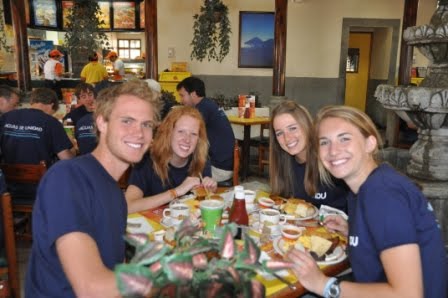
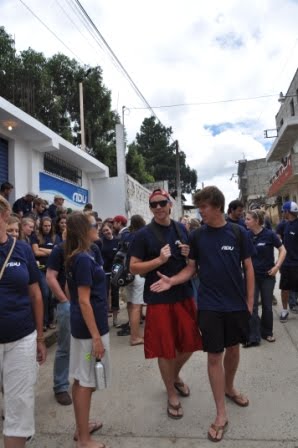
Our group descended on Comalapa, ready to help out Healing Waters/Aguas de Unidad. If you can imagine 60 people all wearing matching shirts coming to town that almost never sees foreign visitors, you can get a picture of what it was like walking through the streets with our group.
We handed out water bottles to the runners at the finish line of the race and also walked all over the community handing out 20 oz bottles and flyers to make the community members aware of the water system.

Here is a beautiful indigenous woman holding on to a flyer that was just handed to her by one of our youth. She is wearing the traditional dress of the indigenous Mayan women in the region. Comalapa has a strong indigenous culture with over 80% of the population having Mayan roots and still dressing like their ancestors. The Mayan women weave beautiful textiles that they wear. You can tell what region of the country they are from by what pattern you see on their textiles.
Of course there is always time for a soccer match. The school where the Healing Waters project is located had a soccer game going on and our youth got involved. The water system is only about 250 square feet, so we brought the youth in to tour the water system in groups of 10 while the other youth waited outside and played soccer.
Here is a photo of the youth getting a tour of the water system. Daniela, one of the Healing Waters/Aguas de Unidad employees based in Guatemala is explaining how the water system works.
What a great looking group standing outside the Healing Waters/Aguas de Unidad system in Comalapa!

As we walked from the water system back to the place where we were going to eat lunch, Angela snapped this great photo. You can see four women in traditional inidigenous dress walking down the street. I love the blend of the modern and traditional and this photo really captures the heart of Comalapa and our experience there.
We arrived back at a different public school in Comalapa where they served our group a traditional lunch. They were so proud to have this big group of Americans visiting their town and they put together quite a feast for us!
Chris really enjoyed his soup and tamale that was prepared for him by the people of Comalapa!
We loaded up into our buses and headed back to Antigua at about 1:30pm. We have a tradition on Mission Trip called Baquet ("Banquet" without the "Q".) The seniors put together an activity or competition for all of the youth to participate in. This year they put together a photo scavenger hunt. They took photos that the Wellshire group had taken when they were down in Guatemala last year. The kids split up into teams and they had to go find the spots where the photos were taken and then snap an identical photo. Each team was also given 100 Quetzales (the local currency) and had to go into the market to buy some specific items.
Angela took the photo below outside the cemetary. The quote reads, "La Vida de los muertos consiste en la memoria de los vivos" which translates to "The life of the dead lives on in the memory of the living."
This is a photo of a "tuk-tuk" which is one of the 3-wheeled motorcycle taxis that run all over the city of Antigua
Here is one of the groups that was competing in Baquet. They found this old car on the streets of Antigua and decided to pose by it.
Once the Baquet activity was over, the team all went to a restaurant for their "Cena de Despedidia" or the "Good-bye Dinner." They enjoyed a delicious meal together and had some fun too!
The seniors handed out awards to all of the mission trip participants based upon their experiences for the week. Some of the awards are funny, some are touching and heartfelt, and some are a little weird. They also had prizes for the Baquet teams that found the most photos and got the best deal on their items in the market.
After dinner was over the group returned to the hotel. Everyone headed up to the roof of the hotel for another mission trip tradition, CIRCLE! This is an opportunity for each mission trip participant to go around the circle and thank everyone on the trip, reflect on their experiences, and share stories and anecdotes about their fellow travelers. They got started at 10pm and finally wrapped up around 2am on Sunday morning.

Wake up call was 3:30am Sunday morning and the buses left for the airport at 4am. I will save the trip home for another blog post. . .

All in all, the trip was incredibly blessed. Prayer is an incredibly powerful force and there was no question that we could feel the power of your prayers during our trip. Everyone made it home safe, and all of our lives have been forever changed by this experience. Thank you to each person who came on the trip, to each family member who supported us, to the Wellshire congregation for their incredible support, and to anyone else who came along side us for this journey through your thoughts and prayers.

Helping to lead this trip was an absolute joy for me. I thank God for the opportunity I was given to expose our youth to a bigger world. I will close with the Mission Statement for our Mission trip, which really represented our experience.

We are going on this mission trip to build relationships with our brothers and sisters and serve the poor. This is an opportunity to be the hands and feet of Jesus to some people whose needs are far greater than our own, perhaps greater than anything we've ever seen. This week is not about "us" or "our experience", but rather it is about the people we are serving. Our goal is not to simply have a “great week” in Guatemala. We will have the opportunity to meet the needs of each other and the poor, to hear the voice of Jesus, and leave the rest up to the Holy Spirit. We will follow the words of Christ who told us to “Love one another as I have loved you” and remember the sacrifice He made to show that love.

Friday, May 28, 2010

Healing Waters to the RESCUE!

Two quick things about Healing Waters to start the holiday weekend:

For those of you that read international news, you know that a volcano erupted in Guatemala last night. The volcano, Pacaya, is about 20 miles from Guatemala City. Most of the 22 Healing Waters systems in Guatemala are in Guatemala City, so there has been a pretty direct impact. While no lava flows are reaching the city, it has been completely covered in a blanket of volcanic cinders and ash. So many cinders have dropped out of the sky that some people who live in houses with laminate tin roofs have had their roofs collapse. Below are some photos from one of our pastors who has a Healing Waters system in his church:


You can see the damage to the laminated tin/zinc roof and the pile of ashes and cinders that collapsed the roof.

Healing Waters is helping out in this crisis in two ways:
1. The churches that have a Healing Waters system are using their funds generated from the system to help their neighbors and communities rebuild from the collapsed roofs, etc.

2. Many of the people that live in the villages around the base of the volcano have been evacuated and are living in temporary shelters until the eruption subsides. Our Healing Waters staff is delivering five gallon jugs of water to these shelter to provide the evacuees a source of safe drinking water while they wait to see if they will be able to go back home.
For more information about the volcanic eruption visit: http://www.cnn.com/2010/WORLD/americas/05/28/guatemala.volcano/index.html?hpt=Sbin


In other safe drinking water news, last night here in Denver there was a water main break. http://www.denverpost.com/ci_15182424


There is a "boil water" order in effect for a large part of the city. Residents have been very frustrated and making a lot of noise about the need to boil their water for the next 24 hours. There is such a lack of understanding that this is a daily reality in developing countries like Guatemala, Mexico and the Dominican Republic where Healing Waters works.

As Americans, we are so used to getting safe drinking water out of the tap. When we are required to boil it, we get upset. But at least most of us have electric or gas stoves in our homes to be able to boil water. We don't have to go out and gather wood, build a campfire, and boil water over the open flames.

One of our founders, Dana Larson, used to talk about "First World" problems. Whenever I get really frustrated or fired up because I am stuck in traffic, or because the line at the grocery store is taking too long, or because I have to boil water for 24 hours because of a water main break, I need to step back and put things into perspective.
-When I am stuck in traffic, at least I have a car and the money to put fuel in the gas tank.
-When I am in a long line in the grocery store at least I live in a country that has grocery stores that have fully stocked shelves of food and I have the resources to buy that food.
-And when the city asks me to boil my water for 24 hours before drinking it, I need to be thankful for the 364 days per year I can just go to the tap and get a glass of safe drinking water. I need to be thankful I have a stove to boil water on when it is not safe. I need to be grateful that I have any source of water piped into my house.

Oh the privilege of having first world problems.

Happy Memorial Day Weekend!

Monday, April 12, 2010

Sushi in the Guatemalan Highlands?

This is a month-old blog post that I have just got around to posting with photos. I was in Guatemala the last week of February/first week of March. Below is my travel blog from the trip. Enjoy!

I arrived in Guatemala on Thursday night and went straight to my hotel in Antigua. I got up bright and early on Friday morning to leave at 6am. I joined Daniela, one of our project managers and Ben, the director of tech and maintenance for Healing Waters/Aguas de Unidad, on a visit to a community we are prospecting for a water system.

The community was a 2 hour drive from Antigua. We arrived and were greeted by the pastor of the church where we are thinking about putting a water system. The pastor is also a doctor and runs a small medical clinic out of the church. In addition to being a pastor and doctor, he also received some dental training when he served in the military, so he also does tooth extractions at his clinic. This is not uncommon at all in Latin America, and especially in Guatemala for a pastor to have two or more jobs. I remember visiting one of our water systems in the Dominican Republic when I was there a year and a half ago and the water system was housed in a church that also hosted a dental and orthodontics office. The pastor had both a degree in theology and a degree in orthodontics.

The pastor had prepared a big breakfast for us. Typical of many churches in Guatemala, the pastor’s residence is connected to the church. So we ate breakfast as the pastor described his community and the work that his church is doing in the community. It was very clear to me from this conversation that the pastor has a very holistic vision of development for his community and sees the church’s call to provide tools and services for that development.

As we were finishing breakfast, some kids in their late teens and early twenties started showing up. These were all members of the church, active in the youth group, who were asked by the pastor to volunteer and help us with our community survey. Dani did a quick training session and then turned the five youth loose in the community with copies of our interview/survey.

Ben, me and the pastor in the church sanctuary talking logistics.

The outside of the church in Tiquisate


While the kids were out doing the survey, we walked around the community with the pastor to get a sense of the population density and culture that exists around drinking water. As we walked through the sprawling central market in the city, the pastor was greeting every third or fourth person by name. It was very clear that the pastor has a large congregation and is deeply invested in his community.

We returned to the church to collect the surveys from the youth group members and we sat around with them and talked. Once they heard that I am the youth director at my church, they got really excited. It turns out on Saturday night, they were planning on having a lock-in/prayer vigil all night. They invited me to come and preach and pray with them. Unfortunately there was not time in the schedule for that during the visit, but if we end of installing a water system in this community, I sincerely hope that I can go back to the church and spend more time there.

We packed up and left. Dani and I headed for Panajachel, the largest town on Lake Atitlan. The Guatemalan ex-pat missionary community has an organization called “Intermissions” and they were having a conference there last weekend. We decided to attend the conference to raise awareness about Healing Waters, look for new potential partners and to recruit for the National Director (ND) position.

It is always our preference to hire locals for positions in our field offices, however because the ND position has been vacant since July, we are trying to leave no stone unturned in our search for the ideal candidate. The difficulty is finding an ideal candidate. The position requires someone who has substantial experience (10-15 years) in business and can understand and help us grow our “water store franchise” model. But the person also needs to have a profound faith, an understanding of the ministry side of what we do, and be able to interact with authenticity with our church partners where we have the water systems. Add to that the need for a bi-lingual candidate and someone who ideally has a college degree, and you can see why this search is difficult and why the position has been vacant for nearly 9 months!

We arrived in Panajachel in the mid-afternoon, got checked into our hotel. Nearly every place here now has wireless internet access, which is an enormous blessing. I can use SKYPE to video chat with Jessica and Esther every day. Even though this trip is only a week long, it is so hard to be away and I don’t want to miss anything in Esther’s growth and development. So I called up Jessica and had a chance to see my wife and my baby girl. It was nice.

We spent the rest of the afternoon and evening at the Intermissions conference. We set up a table and distributed literature and also had the chance to worship with all of the Guatemalan missionaries.

Set up with out "booth" at the Intermissions Conference

After the conference ended for the night, Dani took me to one of her favorite places in Panajachel, the “Pana Rock Café,” which totally ripped off the “Hard Rock Café” theme. There was a live band playing there and the food was delicious!

Me at the "infamous" Pana-Rock Cafe!

Saturday morning we had breakfast at the hotel in Panajachel. They served us the Guatemalan version of "Pancakes" which they call "Pankekes." You can see how thick they are, almost as big as biscuits. But they were light and fluffy and Dani and I enjoyed them.

Dani enjoying her "Pankekes"

After breakfast we returned to the conference and continued interacting with the Intermissions folks. I attended two great break-out sessions. One was based on the book “When Helping Hurts” which I have written about in my blog before. The book deals with the negative impacts that development work has had in developing countries. I strongly recommend it for anyone who is or is thinking about doing development work. The person leading the session talked about the book and its relationship to missions work in Guatemala. It was great stuff.

The conference was winding down by the afternoon, so we packed up our display and left. Just outside of Panajachel is a nature reserve that has a series of high jungle canopy ziplines. I couldn’t pass up this opportunity to go flying through the jungle like a monkey, so Daniela and I stopped off and spent about an hour on a series of 9 different ziplines. The views were incredible and it was a fun break from the conference.

Greg ziplining over the Guatemalan Jungle!

After the fun on the zipline, we left to drive back to Antigua. We got back around 7pm and decided to go to dinner. That is when I was introduced to Sushi Akai! Yes, Antigua in the Guatemalan highlands has a Sushi restaurant! And believe it or not, it was great. I could not bring myself to order any of the actual sashimi or sushi, but we ordered some rolls that were outstanding.

That's right, Sushi in the Guatemalan Highlands. And I didn't even get sick!


On Sunday morning I interviewed a candidate for the ND position. He drove up from Guatemala City to meet me at a nice café in Antigua. The interview lasted over two hours and was very productive. I think we have a pretty solid candidate who we will be continuing to interview. I have to get back to Denver and debrief with our senior team.

I spent most of Sunday afternoon back in the hotel working and catching up on emails. I did go out to grab dinner at The Bagel Barn, and very gringo bagel shop in Antigua that is just off the plaza. I felt guilty afterwards for frequenting such a gringo place, but such is life. As I was wandering back to my hotel, there were Lenten processions marching through the city. Imagine hundreds of people dressed in purple and white robes lining the streets. Down the middle of the street people have laid down “carpets” of flowers in intricate designs. Then they have a parade with huge statues on platforms that are carried down the streets and over the carpets. You can see a photo here:


Monday, Tuesday and Wednesday were all spent working out of our field office. I led a staff meeting on Monday morning with all of our Guatemala staff. I invited the ND candidate to stop by the office and meet the staff as well on Monday. For lunch we all drove into the city and had ceviche at a delicious restaurant. Tuesday and Wednesday I met one on one with each of the staff members to get a sense of how things were going in the office, clarify certain policies and procedures, provide some inspection and accountability to our staff there in absence of an ND, and to hear from the staff how they are doing.

Thursday morning I drove to the Guatemala City airport and flew it. It was a whirlwind trip, but very productive. This was my 5th trip to Guatemala in the past 15 months. I really love being there, but with Jessica and Esther at home, I really love coming home too!